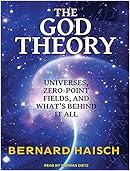
The God Theory: Universes, Zero-Point Fields and What's Behind It All by Bernard Haisch P
- Audio CD
- Publisher: Tantor Audio; Unabridged CD edition (October 24, 2011)
- Language: English
- ISBN-10: 1452604819
- ISBN-13: 978-1452604817
- Product Dimensions: 6.4 x 1.1 x 5.3 inches
- Shipping Weight: 6.4 ounces
On the one hand, we have traditional science, based on the premises of materialism, reductionism, and randomness, with a belief that reality consists solely of matter and energy, that everything can be measured in the laboratory or observed by a telescope. If it can't, it doesn't exist. On the other hand, we have traditional religious dogma concerning God that fails to take into account evolution, a 4.6-billion-year-old Earth, and the conflicting claims of the world's religions. In The God Theory, Bernard Haisch discards both these worldviews and proposes a theory that provides purpose for our lives while at the same time being completely consistent with everything we have discovered about the universe and life on Earth. To wit, Newton was right-there is a God-and wrong-this is not merely a material world. Haisch proposes that science will explain God and God will explain science. Consciousness is not a mere epiphenomenon of the brain; it is our connection to God, the source of all consciousness. Ultimately it is consciousness that creates matter and not vice versa. New discoveries in physics point to a background sea of quantum light underlying the universe. The God Theory offers a worldview that incorporates cutting-edge science and ancient mystical knowledge. This is nothing less than a revolution in our understanding.
Editorial Reviews
From Booklist
Physicist Haisch thinks "Let there be light" isn't just a randomly chosen phrase for the Creation. Indeed, he believes that in the mysteries of light rest clues to the deepest mysteries of the universe, something he calls God, though he doesn't mean by that word the personification that some believers prefer. A scientist who has worked in astrophysics and theoretical physics, Haisch has retained his wonder at the universe from childhood, as he describes in the affecting memoir with which the book begins. Many scientists find no tension between their profession and the profession of belief in divinity, but Haisch goes one step further by attempting to find a scientific explanation for the phenomenon generally called God. Light, that familiar but utterly mysterious force, is the key to such an understanding. Readable and engaging, Haisch will be embraced by those concerned with finding ways of reconciling science and religion. Patricia Monaghan
Copyright © American Library Association. All rights reserved--This text refers to an out of print or unavailable edition of this title.

No comments:
Post a Comment